
Reflections on Knobcon 2026, Burnout & the Linux Weeds

I recently performed again at Knobcon. I've attended Knobcon 7 times starting in 2017, and performed in 2020, 2021, 2022 and now this year. I had a great time this year and rather than the gear it was all due to seeing old friends and just enjoying being immersed in my element and as well as being able to share it with my partner. Ironically I did not know about my neurodivergence when I started going to synthesizer conventions, only to discover once I disclosed it to friends that most of the attendees at Knobcon are as well.
This year was the maiden voyage of my Bitwig & CachyOS & modular live setup and despite some software quirks of not really being experienced with Bitwig in the live situation and a several minute delay to starting my set, the audience was very receptive. I typically go through a self torment type of process preparing to play live, but the big difference this year was how I took steps to not allow myself to get frustrated while preparing. Of course I did not achieve everything I set out to do with the setup but I forgave myself for that before I even started.
Preparing in my new patient way led to a lot more enjoyment of the process itself, and I returned home creatively invigorated. I've actually begun working on the album I should have finished years ago again and made some actual progress.
Burnout has more or less destroyed my creativity for about 4 years and I am one of these stereotypical people that suffers cyclical burnout due to being extremely driven. I've been seeking an answer to stop the cycle and it has slowly improved, but I am still suffering. The biggest challenge of the cycle lies in maintaining the belief you can succeed no matter how difficult it seems at the time and being mindful of when NOT to push through, and when to give my mind rest. Think of it as stopping before you hit "the wall" with full force.
Migrating from comfortable MacOS to bleeding edge linux has obligated me to look beyond what look like impossible hurdles to see that paths over and around them. And to that end, a bit of a hardware update:
My main linux system is a Starlab Starfighter Ultra with Coreboot firmware. After some really trying issues getting it stacked with 8TB of storage and fighting with secure boot (secure boot in linux is truly awful owing it it's own post), I have finalized it and now depend on it. It's larger and heavier than I'd like but is a lot quieter than other pc laptops, has an excellent keyboard, and really handles power states well.
I have abandoned my Lenovo X1 Carbon Gen12 due to low processor clock as much as I loved the form factor. I've also abandoned my Steam Deck OLED, which is a great system really--the reason I dropped it is not related to audio. My Ryzen 9975WX workstation is now running local AI models when not in direct use, and I am slowly learning how to leverage them.
For audio hardware, the right tools have come into focus: For about 6 months I used RME Babyface Pro FS as the centerpiece with one BoredBrain Optx v2 counting on the additional balanced in and outs for additional sound. In the end this was really limiting if I wanted to truly use both in and out on the Optx, and because even in Class Compliant mode routing to every channel became a real pain as well as monitoring not able to work simulaneously over headphones and the main outs.
In the time I was working on that RME released class compliant firmware for Digiface USB which has turned out to be the ideal CC audio interface for me. All the routing, once you lock it into the "Pro" mode, is easily available in Bitwig with pulseaudio-jack (regular jack is too much hassle) or ALSA direct. It's smaller and cheaper and allows me to connect up to 3 Optx V2s and a Ferrofish Pulse 8 AE simultaneously. The optx all lock immediately at 24/48 and Ferrofish can configure all of its settings directly at the device. All of this and I'm able to stably do a live performance at 24bits with 128 samples using linux-cachyos-rt-bore kernel.
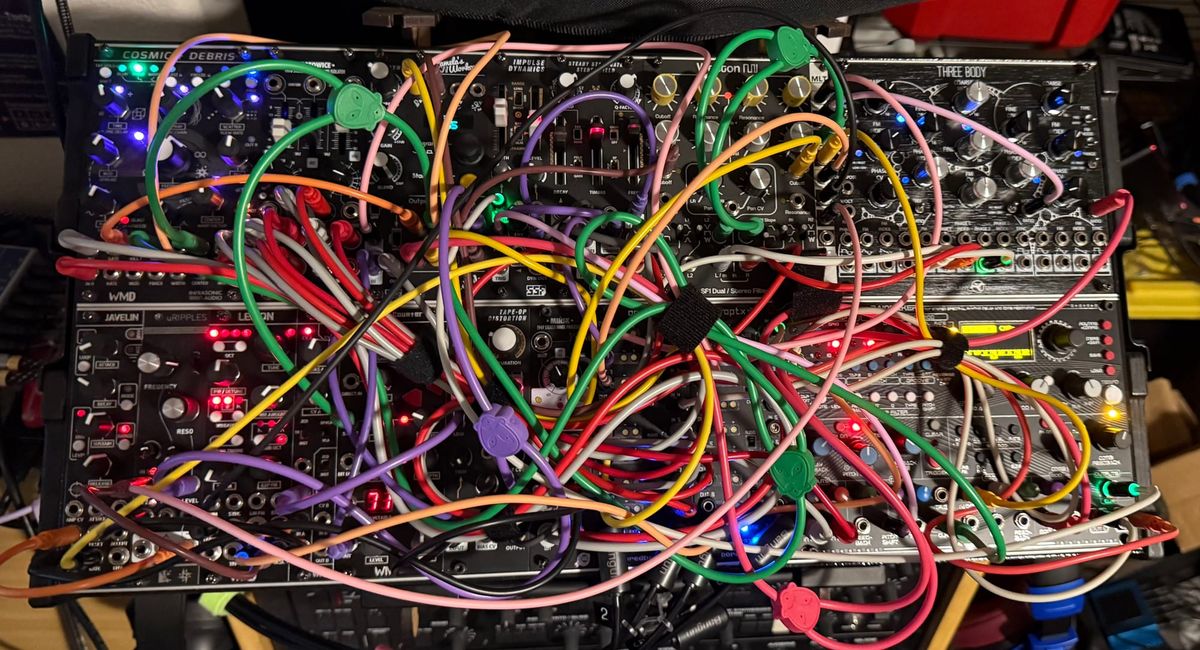
In my Erica Synths backpack eurorack case I intentionally limited myself to 2 complete synth voices and made them playable by making them highly modifiable through FX and variations using stereo mid-side processing and 3 band EQs. In all it worked, but I certainly missed having more touchable controls. In terms of digital transport and mixer control I still do not have that sorted out completely. And the still missing holy grail for me is live key modulation within songs, specifically meaning using different musical scales to weave a narrative with the tonal part of the music.
I realize I can delve much deeper on each of the subjects in subsequent posts, but suffice it to say that the discovery process that led me to the Knobcon performance has me excited to learn the setup better and push it further.